Contre=Danses
À Paris
1818
&c
Contents
| 19 | |
| 19 | |
| 7-15 | |
| 41 | |
| 47 | |
| 49 | |
| 51 | |
| 55 | |
| 59 | |
Pastoràle and other additional figures | 61 & |
| 119 | |
| 83 | |
| 151 | |
| 173 | |
| 175-180 | |
| 181 | |
| 183 | |
| 191 | |
| 195 | |
| 211 | |
Country Dances (missing page) | 223 |
| 225 | |
| 227 | |
| 227 | |
| 229 | |
| 231 | |
| 233 | |
| 233 | |
| 235 | |
| 237 | |
| 241 | |
| 241 | |
| 243 | |
| 243 | |
| 245 | |
| 245 |
Pantalon
Transcriber: These descriptions are basically the same as those in Payne's 1st Set of Quadrilles.
Chaine Anglaise
Balancez a vos dames
Un tour de mains
Chaine des dames
Demi queue de chat
[ou demi promenade]
Demi Chaine Anglaise
Contre Partie
Eté
En avant deux
Chassez, Dechassez
Traversez
Chassez, Dechassez
Balancez a vos dames
Contre deux et
Contre Partie
Poule
La main droite a la dame de vis a vis
Traversez main gauche en main gauche
Les Dames donnent la main droite a leurs Cavaliers. Balancez
quatre sans vous quitter
Demi queue de chat [ou demi Promenades]
En avant deux
Dos a Dos
En avant quatre
Demi Chain Anglaise
Contre deux et
Contre Partie
Trenise
Chaine des dames
Balancez a vos dames
Un tour des mains
Un Cavalier conduit sa dame deux fois en avant el la laisse
a la gauche du Cavalier de vis a vis.
Les deux dames traversent a la place opposèe et dans la
meme position pendant que la Cavalier traverse au milieu. Le Cavalier faite
un rigaudon et les dames ferent un chasse croiser
Les Cavaliers balancent, avec les dames.
Contre deux et
Contre Partie
Finale
Chassez crosser dechasse
Ete
Chassez crosser dechasse
Contre deux et
Contre Partie
1849 Now altered to
Chassez; or gallope, round once; all [or advance + retire twice] — | 8b |
1st set: advance + retire and cross over:
[or change partners.] — | 8b |
— Chaines des dames. — | 8b |
— Adv: + Retire; + cross over [or re:exchange partners.] — | 8b |
Chassez; or gallope, round once; all round once [or advance + retire twice] — | 8b |
In all | 40b |
Note 1818.
During the long war; we could neither get dances nor any
thing else, conveniently from the French, that nation of dancers.
In april 1814, however Bonaparte went to Elba; and several
teachers shortly thereafter went to Paris; from which place they imported
Waltzing and the Quadrille.
It was not however till 1815, that they acquired the true
French style; and it was still several years before it came to be generally
introduced, as the quadrille now is, to private parties.
With regard to Waltzing it was the rage in Scotland
but only for a very short period, not exceeding two years; nor can any
reason be given for its disuse excepting a ludicrous circumstance which made
some noise at the time, after which Waltzing almost immediately died away, has
never since been revived.
The Earl of Wemyss had a waltzing party to which several
persons of distinction were invited and among others some military officers.
One of these officers being thin+slender, and having a sort of Lady-face got
himself dressed as a female, unknown to the whole party; with the exception of
his friend who introduced him as Lady Corstorphine. No such noble Lady had been
heard of before, by any of the party; but as her Ladyship seemed handsome and
was elegantly dressed, she was of course well received! The Waltzing accordingly
went on; but in the course of it, Lady Corstorphine fell on the floor on
her back, and her partner right over on his face above her. The party were
instantly thrown
into confusion, and the waltzing stopped for that evening. From that evening
waltzing fell into disrepute and completely died away!
[Very much I think to the honour of Scotland.*]
It is still
taught to children and the steps are worth learning for doing the Pousset in
the ordinary Country dances.
* I say this not on account of incident above related,
but on account of the general indecency of many of the attitudes).
The Strathspey steps are not in disuse & ought by all
means to be kept up being the only sort of dancing we have, strictly national
and peculiar to Scotland.
Reel of three.
No. 1.
Each Lady chasses round and returns to her former place
The Gentleman sets first to the one Lady and then to the
other as in the Reel of Four. ?But/Back.
The figure described by each individual is the figure 8.
No. 2.
Same with No. 1 excepting that each individual takes a turn in
the middle in rotation. At the change each individual chasses a place further
than in No. 1. and for one two turns at the middle is twice once at either extremity.
Reel of four.
Properly it ought always to have the cross in the middle thus;
The practice of going quite round is not nearly so elegant;
but it was introduced from England two or three years ago under the name
of "fashionable", most probably because in England this reel was never
properly understood or valued.
Reel of Eight.
No. 1.
Eight hands all round — | 8b. |
Ladies right hands across; gentlemen outside; half round — | 4b. |
Gentlemen right Hds. across Ladies outside, back
again. — | 4b. |
Set and turn partners | 8b. |
The Grand Chaine; [right and left all round.] | 8b. |
In all — | 32b. |
Reel of Eight.
No. 2.
Four Couples arranged in two lines as for a Country Dance.
8 hands all round — | 8b. |
Set & turn partners — | 8b. |
Hands across in two parties, one at top, one at bottom;
— and back again. — | 8b. |
Hands round in two parties; " " — and back again. | 8b |
Pousset 1st: with 2d: +
3d: with 4th: Couples. | 8b |
The Chase or Procession as in "Les Lanciers"
7 Chasses + jette Assemble | 8b |
In all — | 48b. |
Quadrille
The music is similar to that used in ordinary country dances, being
divided into parts of 4 bars; [=4 D Steps] each. Four of these parts generally
make the tune.
Four couples make a party. At the outset they stand thus.
Before commencing, the party stands till 8b. of the music
are played; and they do the same at the commencement [of] each new figure. At the end
of the first 4 b. salute.
| Chasse R. before | |
| " L. before | |
| " alternate | |
| " commencing | |
| Jetté R. before | |
| " L. before | |
| Assemble R. before | |
| " L. before | |
| Glissade R. before | |
| " L. before | |
| Commencement of the first gentleman's figure denoted by | |
the small mark | |
| His partner | or |
| Opposite gentleman | |
| Opposite lady | |
Figure I. Le Pantalon
| |||||||||||||||||||||||||


|
1. Here you advance freely but retire less ?than you have advanced
because (you) have to dance to the right and left
in a parallel line before your Partner. You
were in the same line with her when you get out.
New "Etè" (probably a later addition)
1. Ford 3 slides + Assemblé left behind back
3 " + Ass: R: before Repeated.
2. Four slides: one chasse: then Jetté L. before
+ assemb. Right before.
3. Ford and back as in 1. Repeated
4. Votre avec Contre Deux
|
Figure II. L"Eté
| ||||||||||||||||||||||||||||||||||||||||||||


|
ˣ The mark shows where the Gentleman +
Lady passing each other give the right or left hand.
ˣ See this mark ??? See also the full
right + left Figure described P. 77
†. 3. Here while setting the Ladies face one way their partners the
opposite way.
‡ 5. Each Gentleman with his
partner is now at the opposite end from which they set out to which he is
immediately to return by half right + left. See next Page.
|
Figure III. La Poule
| ||||||||||||||||||||||||||||


|
ˣ This mark shows where the gentleman +
Lady passing each other give the right + left hands.
Votre avec Contre Deux
|
| |||||||||||||||||||||||||||||||||||||||||||


|
Votre Avec Contre Deux
|
Figure IV. La Trénise
| ||||||||||||||||||||||||||||||||||||||||||||


After which comes La Finale.
See next Page.
| |||||||||||||||||||||||||


|
Chassé all round with partners.
|
Figure V. La Finale
But see P. 15.
| ||||||||||||||||||||||||||||||||||||||||||||

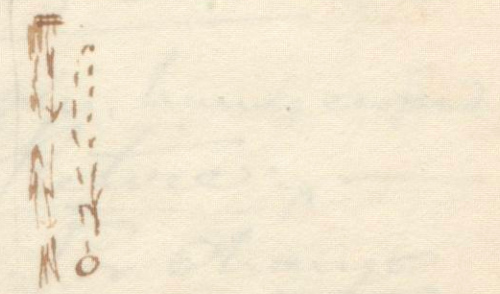
|
*☞ Query? Contre Deux? 40 b
[Believed to be omitted here?]
Then See P 60/4 Note 3.
|
Figure V La Finale
[1849. P. 15.]
|
|
*the advance + retire each couple join hands cross;
and advance and retire as in the galope;
Also observe that in crossing. |
Figure V La Finale
1849. Notes, on P. 60/2]
|
Additional Figures1. La Pastorale.
| |||||||||||||||||||||||||||||||
2. Garçon Volage.
| ||||||||||||||||||||||||||||||||||
Right & Left Part I
| above round return Lady's tracks |
 |
☞ The space or stretch it will be
observed is occupied by these chassés. The mark at the end
is omitted for want of room.
Right & Left Part II
| ...above ...move ...nits ...nihid ...nd an erty. ...explode |
 |
See Part II Explained further in the two following pages.
Right & Left. Part II.
Transcriber: This page looks to me as if it had been deliberately erased, possibly
several times. The images (themselves faint) looks as if they were drawn
on top of earlier ones or earlier text. A kind of palimpsest.
I'm not even going to try to reconstruct this page. I think two reconstructions
would be needed, but I can't see either text well enough. And anyway
the author erased it. He didn't want it used.
Paul Cooper suggests the following:
[left of image] into contrary place by chassés.
[left of image] The l.[lady]moveintoret:d.by d: [do.]
[left of image] both lines seen together
Right and Left. Part I

The marks ˣ denote at which right and left hands
are given. — 3 Chassès and Jettè Assemblè. 4.b.
Right & Left. Part IId:

Right and Left.

The above is said to be the correct Parisian figure.
Part II is the same with Part I: the couples having merely exchanged sides.
Country Dances
In describing these several terms ?occur, which it may be useful to explain.
1. Moulinet; or Hands across; or Hands four across
This requires no explanation; done by two couples as in the reel of 8. —
Right hands across in going. Left hands in returning. 8.b.
2. Hands across half round.
I.e. right hands. Moulinet Part I. 4 b.
[Sometimes followed by ?half set, 4 b. to fill up the music.]
3. Hands across with left hand or "Hands with the left hand".
I.e. left hands Moulinet Part II. 4 b.
4. Hands four round or "Hands six all round".
Here the couples join hands so as to form a ring or chain;
chassé round to the right + then to the left, back again 8. b.
5. Hands four at top.
Hands round in a ring or chain with the top Couple or a couple
above you. Chassè to the right once round. + to the left back
again 8b
6 Hands four round at bottom.
Do the same with the bottom couple or couple below
you.
7 Lead down the middle and up again.
Chassé down with your partner holding her hand as in
tour des mains. or rather holding her right hand by your left going
down and her left by your right coming up. 8.b.
8. Cast off." "Cast off outsides or [as it is now usually termed] "leave off a couple."
Formerly after coming up the middle you went round to the outside
and cut off the couple. This is now in disuse. They merely move up, and
you leave them off, one couple in each figure.
9. Swing Corners.
The gentleman turns the 3d: and 2d Lady,
while the Lady turns the 2d and 3d Gentleman. Un tour
des mains at each of these four corners 8b=16b
In each turn the Gentleman and Lady turn quite round as on
a circle. 4. b.
10 Gentlemen turn the Ladies with right hands.
Join right hands. Keep hold and Chassé round the usual
circle.
11. Cast through the 3d. and 2d. couples or Figure eight round the 3d. and 2d. couples.
2d Couple
3d Couple
Transcriber: The author has seven drawings of this figure. He seems
to have intended to draw the above, but I may be wrong. Hugh Thurston had
a different idea - which didn't look like any of the original drawings to me.
None of the drawings (not even Thurston's) seems to follow the description.
Here the Lady chasses thro the 3d: Couple before
her gentleman. He follows her. Then through she turns to the right and goes round
the gentleman of couple 3d: He turns to the left and goes round the lady of
Couple 3d: They then do the same to Couple 2d: as in the
common figure.
The same may be done with the 3d + 2d
Couple if required merely reversing the order.
Transcriber: This is my guess as to what the author should have drawn:
2d Couple
3d Couple
12 Right and Left.
Is different a little from the quadrille right+left;
for there you go quite round keeping your face one way.
Done by two couple; and the hands are given the same
number of times as in the quadrille. The 1st: gentleman in going gives
his right hand to his partner + his left to the 2d gentleman; on
whom he immediately turns his back. In returning he gives his right hand to the
2d Lady This must be a misprint for "his partner" + his left again to the 2d gentleman he again
turns his back. 4 b. & 4 b. = 8 b.
Transcriber: Hugh Thurston points out this does not involve a polite turn.
In the quadrille after giving the left hand you turn your
face to the Ladies.
See Note on P. 99
13 Half right and left.
A way by which the first Gent: changes places with the 2d
Lady, and the 2d Gent: with the first Lady. Right and left Part I.
4 b.
As of the second half a way of getting back to your
places the above exchange having been previously made
14. Half right and left with the top couple.
In this case the first gent: exchanges places with the Lady of
the Couple above or top couple: giving the right hand to his partner [in going]
and his left to the gentleman in going.
Note on Right + Left
The last term ?both suggests the path of the 2d
gentleman in right+left. He moves as the first Lady wd.
do in the quadrille In going, gives his right hand to his partner + then
his left to the first gentleman; He moves quite round in a sort of circle but
it is the opposite of the circle moved by the first gentleman
|
1st: Gent: 2d Gentn: |
15 Change Sides and set, back again and set.
May be done by one two or more couples
Two chassès across; giving the right hand to your partner.
2 b. Two Pas de Basque (having faced about), ?other? 2 b. = 4 b
The same back again.
?I.e. the same chassés across and set; as in La Finale.
16 Promenade three Couple.
The Gentlemen join both hands with their partners facing up
the dance + Promenade once round so as to return to their places. 8 b.
Ladies arms uppermost always. Her left arm crosses your
right midway between your wrist and elbow: as in the ?adjacent figure
The small marks [] show where hands should join.
In this promenade the gentlemen move very little off their
line but the Ladies go round + thus make a larger circuit.
|
Pousset Ascend by the Satteuss waltzing Step.
|
17 Poussette.This figure is distinguished into Poussette, half Poussette
and Double Poussette. Each of these three may also be distinguished into two
kinds according as you ascend or descend in performing the figure.
The Poussette may be gracefully performed by the Sauteuse
Waltzing step.
At each time two couples are employed one of whom ascends
and the other descends in the figure. In half Poussette, of course they stop
short in the middle and thus exchange places.
In Double Poussette ...
|
|
Pousset Descend.
Bar: 1. Same as Bar 2 P. 104
Bar: 2. Same as Bar 1 P. 104
&c
Bar: 7. Same as bar 2 P. 104
Bar: 8. Same as bar 8 P. 104
|
the same couple repeat the figure
successively with other two couples: first ascending and then descending.
The Phrase is obviously improper. It ought to be simply "Poussette with the top + bottom couples."
In the half Poussette each couple describes half
a circle, and in the course of it each couple turns round once.
In full poussette they describe a full circle and turn each other
round twice. In double poussette the dancing couple describes two
circles, each of the other two couples one circle.
It is not easy to devise a figure for showing ...
|
|
the lines
...described in Poussette. You hold your Partner; as in Tour des mains. And
In some country dances Poussette follows after the Ladies and
G. have changed sides; but they must finish on their own sides. This is accomplished
by making three turns only instead of four; and setting two bars to fill up the
music. It might be also by making 5 turns where the room + music might allow it
which seldom happens.
|
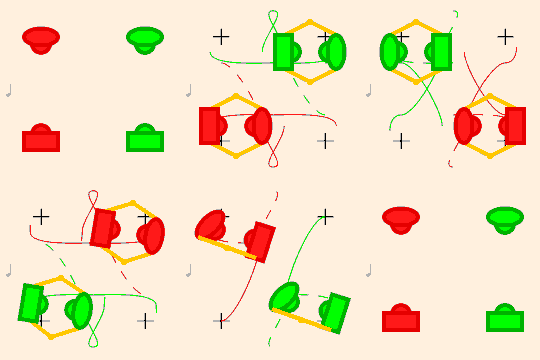
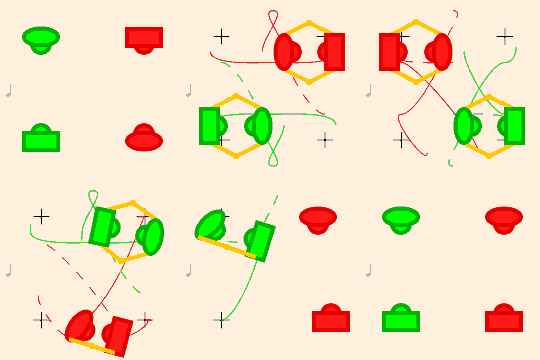
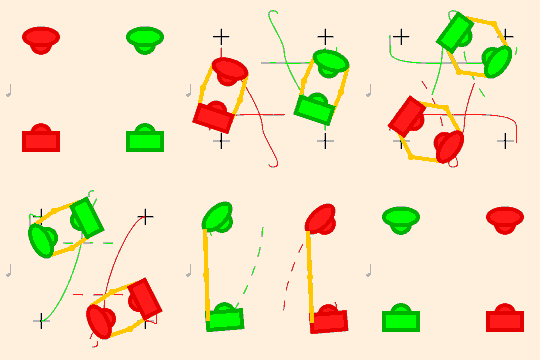
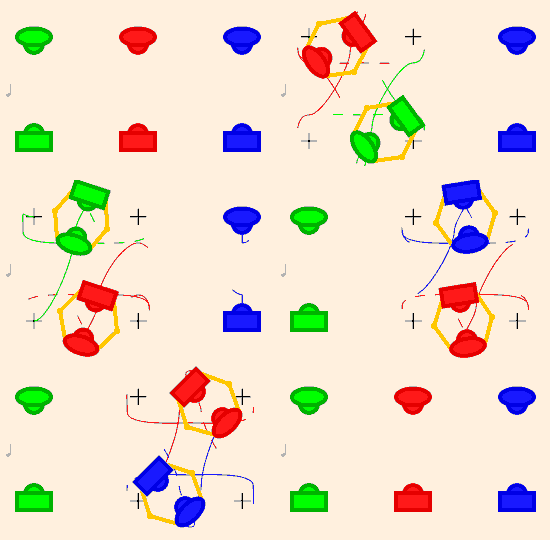
18. Three Ladies lead round three gentlemen.
The gentlemen stand still [or chassè across half set + retire.]
while the Ladies dance to the right quite round the gentlemen. The Ladies have their
hands joined as in "Hands round." and in the end are at their former
places. 8b
19 Three Gentlemen lead round three Ladies.
The Ladies now stand still [or chassé set + retire.]
while the gentlemen dance to the left quite round them. 8b
20 Allemand.
Transcriber: The document contains an entry for "Allemand"
but where there should be a description, there is merely a blank space.
21. Hey: Contrary sides.
Gentleman reels three with the two opposite Ladies, the
Lady with the two opposite gentn. i.e. with top+bottom couples 8b

Hey on your own sides.
Gentleman reels three with top + bottom Gentlemen. Lady with
the top + bottom Ladies. 8b

Hey Proper supposed
1. Set+Tern

2. Reel Three

See Terms used in Country Dances Cont. P 135
Quadrille terms
1. Right+Left. Chaine Anglaise.
Gentleman crosses over in a ?half figure eight giving the
right hd to opposite Lady + left to his Partner. 4. b.
Same back again 4 b.
— In all 8 b.
See P. 77.
2. Set + Turn
Balancez a vos dames & un tour des mains.
Dance opposite to your Partner 4 b. Join hands with her:
arms round & extended. Turn both round on a circular line. 4 b
In all 8 b.
3. Ladies chain. Chaine des dames.
The Gentlemen dance round in the opposite line of the circle
last mentioned. 4 b near the end of which they are joined respectively by the
opposite Ladies.
The gentlemen then dance round again in the same figure and
are joined by their partners.
It is their two Ladies who make the chain.
On joining they give and receive right hands with the
gentlemen at each end.
Transcriber: Er, they should give left hands with
the gentlemen
4. Half Promenade. Demi Promenade.
Nearly as in the Country Dance but; half; - is of course
only 4 b. & in ?ow direction.
5. Advance + Retire. En avans & en ... .
Chassè ford. - 1 b Jette + assemblé 1 b. In all 2 b
Chassè backwd. - 1 b and Jette + assemblé - 2 b.
In all 4 b
6. Dance to the Right + Left or Chassez et dechassez.
2 b to the right +
2 b to the left
2 b to the left
4 b for all.
?Lunt variety of steps for this.
7. Traversez or Cross Over.
4 Chasses: [or 3 Chasses + Jette, Assemblè] 4 b
(Sometimes 1 Chassè glissade assemble; + 1 Chasse glissade assemble 4 h]
In the figure you move from one corner transversely to another.
8. Chassè across Chassè Croisez.
Chassè merely to the one side 2 b. and set to fill up the
music 2 b
In all 4 b
9. Advance + Retire Dos a Dos.
[or simply Dos a Dos.]
Chassè ford: jette, assemblè to the right; then Chasse back again +
jette assemblè Passing the opposite Lady back to back.
Instead of Chassé back; you may turn and Chasse ford: to
your place turning round at the concluding Jettè Assemblé.
10. The Grand Chain.
This is performed by eight persons doing right and left
quite round and without stopping till they reach their original places
The Gentlemen go found to the right. The Ladies go
round to the left. 8 b.
 |
ˣ gentleman's Orig Place Lady's " ⁛ Hands given. — Gentln line ═ Ladies' line. |
Each gentleman gives
his right hand first to his partner + passes her [1 Chasse;] -
then his left hand to next Lady + passes her (2d Chasse.) then his
right hand to 3d Lady + passes her (3d Chassé) then his
left hand to the 4th Lady + Passes her; (4th Chassé) He is now
half round the circle + is now met by his Partner who has been also moving:
goes through the Same again + then reaches his place 8 bars
Terms used in Country Dances Cont from P. 117
22. 1. L. and 1. G. turn to their right + set 4 times. 8 b
The gentleman turns + sets between the bottom Cu: + his Partner sets opposite to him. 2b
He turns again + acts on the Ladys side + she in his place. 2b
He turns again + sets at the top, looking down the dance + she between the bottom Cu. 2b
They ?Now turn into their original places + set 2b
In all 8 b
23. Cross over two Couple and lead up one.
Cross, giving your right hand to your partner; she goes round
the back of the 2d Gentleman while you go round the back of the 2d
Lady. You then cross each other again giving right hands
she going round the back of the 3d Lady + you going round the 3d
Gent: You then meet below the 2 Cus having crossed over them. You there
"lead up" the middle one Couple; stop, ?fixing between the two
or leaving off the top couple.
24. Chain Figure.
Transcriber: The document contains an entry for "Chain Figure"
but where there should be a description, there is merely a blank space.
A
Selection
of
Reel Steps
or
Steps for Setting.
1818
Quadrille Steps for Setting.
No 1.
Glissade dessous to right
Assemble right behind
Glissade dessous to left
Assemble left behind
Assemble right behind
Glissade dessous to left
Assemble left behind
Et & Contre
2 times 8 b
2 times 8 b
No 2.
Glissade dessous to right
Assemble right behind
Assemble left behind
Assemble right behind
Assemble right behind
Assemble left behind
Assemble right behind
Et & Contre
2 times 8 b
2 times 8 b
No 3.
Glissade dessous to right
Sissone right behind
Sissone right before
Assemble right behind
Sissone right behind
Sissone right before
Assemble right behind
Et & Contre
2 times 8 b
2 times 8 b
No 4.
| B1. | Glissade dessous to right |
| " | Changement de Jambe; passing left foot into Pos IV before. |
| B2. | Jettè before with left foot Passing the right foot into Pos: II Tendu. |
| " | Assemblé right behind. |
Et & Contre
2 times 8 b
2 times 8 b
No 5.
| 1. | Glissade dessous to right & |
| " | Sissone dessous, with right |
| 2. | Jetté before with right & |
| " | Assemble before with left |
Et & Contre
2 times 8 b
2 times 8 b
|
No. 6
A composite Step. Learnt first. Jetté dessus right before
assemble, left behind Jetté dessus right before, Pas de Basque left forward.
Et & Contra
The alternatives wrote after this to be connected in separate movements?
|
No 6.
Et & Contre
2 times 8 b No 7.
Et & Contre
2 times 8 b |
|
☞ This step only done to one side. ?Indeed none of the Quadrille steps
whatsoever are for more than 4 bars. Not one of them for 8b.
|
No 8.
2 Times [i.e. once & Contra] = 8b
No 9.
Et & Contre
2 times 8 b |
No 10.
| B. 1. | Glissade dessous to right ford with the left |
| " | Glissade dessous to " |
| 2. | Jetté with right before |
| " | Assemblé left before |
Et & Contre
2 times
2 times
In the last assemblé take care to rest principally
on the foot behind that the other may be ready to go off into the two next
glissades.
No 11.
Glissade dessus to right
"
Jette before with right
Assemblé before with Right.
"
Jette before with right
Assemblé before with Right.
Transcriber: My copy is missing this folio.
No 12. Pas de Basque
| B. 1. | In Pos V. Right before. Spring off right into Pos: II a little back. |
| " | Slide left into Pos IV. before. |
| 2. | Slide up right into Pos V. behind. |
| " | Rest one second. |
Et & Contre
4 times 8 b
4 times 8 b
Pos: III is often substituted for Pos V. in this step.
No 13
| B. 1. | Glissade dessous to right |
| " | " to " |
| 2. | " to " |
| " | Assemblé right behind |
Et & Contre
2 times. 8b
2 times. 8b
Used often for Chassez Dechassez
in L'Etè of the Quadrille.
No 14
| 1. | Assemblè right behind |
| " | Assemblè left behind |
| 2. | Assemblè right behind |
| " | Glissade dessous to left. |
Et & Contre
2 times. 8b
2 times. 8b
Analogous to No. 9. but more elegant and more improving as an exercise.
Une Petit Battemens
3d Pos:
2 Pos: right; and in to 3d.
softly 8 times. Knee steady
softly 8 times. Knee steady
Et & Contra
Une Grande Battemens
3d Pos:
2d Pos wh Right
spring right into 3d Pos:
spring right into 3d Pos:
8 times
Et & Contra.
Chassé
| 1.B. | In Pos: I or at least a rectangle. Right
ford. in to Pos IV. before. |
| " | Left forward behind it; [or rather with a
spring into its place.] |
| " | Right ford: into Pos: IV before |
| " | Left up Parallel to right: rise on right toe as
left passes |
| 2d:B. | Left forwd. into
Pos IV before |
| " | Right up behind it; [or with a spring into its place as above.] |
| " | Left ford: into Pos: IV before |
| " | Right up Parallel to Left: rise on left toe as
right passes |
| 3d:B. | Right ford: &c |
4 times. 8.b.
Be careful to keep the feet always at the same...
...angle as when you set out and your knees perfectly straight.
The knees ought never to be bent except when bringing up from
behind to go forward: which is a natural bend.
Assemble behind.
R. int Pos. II
" back with a spring into Pos V. behind.
Glissade to the L.
R. in Pos III or V. before: slide it out into Pos: II
In the next second bring up the right into Pos. V. behind. This is all.
Et & contre
Jetté with the R.
R. in Pos III or V. before: slide the Left out into Pos: II
Next second bring R. back into Pos: V. before at the same
instant bending the L. knee so as to suspend the L. foot behind with the toe
touching or nearly touching the ground. The L. foot perpendicular and close
behind the right leg. !!!!!!!!!!!!!
Pas de Basque.
Right in Pos: III or V before close. Spring it off into Pos:
II a little back &
Next second spring L. into Pos IV. before; and
Next second bring up R close into Pos: III or V. behind.
Strathspey Steps
There is a considerable difficulty in describing the
Strathspey of Scots Reel Steps.
The prominent and peculiar strathspey step is a compound of
Sissone and assemblé preceded and followed by a hop on the other foot, Thus to
take the Step No 1. P. 195 for
example it consists of:
| Bar 1st: | Hop on left + Sissone with right. assemblé with Right before and Hop on left. |
| Bar 2d: | Assemblé wh Right before
& Hop on left. Chassè to left. No.1. |
| Bar 3. | Hop on right + Sissone
with left. Assemblé with left before + Hop on right. |
| Bar 4. | Assemblé
wh. left before & Hop on right. Chassè to right. No. 1. |
Two times. 8. b.
This Chassé is performed by bringing the
left behind and then moving the right to the right; after which
you instantly set the left, so as to proceed with the next hop + sissone if
necessary; — [or E. Contra; if it be the Chassè in Bar 2d.]
— The Chasse occupies this time of ½ bar; or one Crotchet.
From the above analisis of the Step No. 1.
it will appear that in each half bar there are two...
...steps one by each foot. Those two steps are performed in the order
above set down; but the follow each other so quickly as to appear
simultaneous.This is the compound so very easy in practice but so difficult
to be described.
It would be convenient to have one term for
describing shortly this above steps but as no such term has hitherto been
invented in the following
notes, the Syllable Strath is merely prefixed to the usual terms
Sissone and assemblé; and also to the Chassè to distinguish
it from the common...
...chassè to which it has but little semblance.
If any other steps or terms for steps are used they will be
taken notice of in the annexed table; and the difference between them in the
common dancing and in the Strathspey will be pointed out.
Terms Explained.
- S. Sissone
- Sissone, with a hop before it on the other foot. 1 Crot
- S. Assemblé
- Assemblè, with a hop after it on the other foot.
- S. Chassé to left. No.1.
- The right is put in behind, and the left moved off to the left. [The right is then set down before; for the next hop and step.]
- S. Jetté
- Jetté with one foot and a hop immediately after it on the same foot. Generally Tendu. May be either before or behind.
- S. Chassé. No.2. To left.
- Pass right foot in before the left. Then the left to the left.
[And the right in before it again for the next Step, sissone or whatever it is]W. Contra.
To right.
Strathspey Reel Steps
No.1.
| B. 1. | Strath: Sissone with Right Strath: Assemblé wh " before |
| B. 2. | Strath: Assemblé wh " " Strath: Chasse No.1. to left. |
Et E. Contra
2 Times = 8 b.
2 Times = 8 b.
No.2.
| 1. | S. Sissone with Right S. Assemble wh Right behind |
| 2. | S. Assemble wh Right before S. Chasse No.1. to left. |
Et E. Contra
2 Times
2 Times
Strathspey Reel Steps
No.3.
| 1. | S. Sissone with right before S. Assemblé right before |
| 2. | S. Sissone with left S. Assemble wh Left before |
| 3. | S. Sissone with right S. Assemble right behind |
| 4. | S. Assemble Right before S. Chasse No.1. to left. |
Et E. Contra
Once := 8 b.
Once := 8 b.
Strathspey Reel Steps
No.4.
| 1. | S. Sis: with Right S. Assem: right before |
| 2. | S. Sis: with left S. Assem: left before |
| 3. | S. Sis: with right S. Ass: right before |
| 4. | S. Ass: right behind S. Ass: right before. |
[ & S. Ass: right behind forward combined on the next step.]
Et E. Contra
Once. 8 b.
Once. 8 b.
No.5.
Same with the above No: 4. But in Bars 3 & 4.
also in Bars 7 & 8. Pirouette neatly round;
1st. time to the right
2d time to the left.
1st. time to the right
2d time to the left.
No.6.
Same but with the two Pirouettes in the Centre and concluding as you
begin with Bars 1 & 2.
Strathspey Reel Steps
No.7.
| 1. | S. Sis: with Right S. Ass: right before |
| 2. | S. Ass: right behind S. Ass: right before [and S. ass: right behind forward combined
with next step.]
|
Et E. Contra
2 times. 8 b.
2 times. 8 b.
No.8.
Same. But Pirouette to the left in Bars 3 & 4. and
to the right in Bars 7 & 8.
No.9.
Same. But the two Pirouettes in the center, bars 3·4·5&6
and concluding with Bars 1 & 2.
Strathspey Reel Steps
No.10.
| 1. | S. Jettè Tendu with right before S. Jettè Tendu wh left behind. |
| 2. | S. Chassè No1 to Left S. Sissone with left before |
Et E. Contra
Two times. 8 b.
Two times. 8 b.
No.11.
| 1. | S. Jettè with right before S. Jettè with left before. |
| 2. | S. Chassè No2 to left [See P. 193] S. Sissone with left before |
Et E. Contra
Two times. 8 b.
Two times. 8 b.
|
Dessous means behind
Desus above or before |
Quick Reel StepsNo.1.
Et E. Contra
4 times. 8 b. No.2.
Et E. Contra
2 times. No.3. Same with Quadrille Setting Step No 6.
See P. 157 |
Quick Reel Steps
No.4.
| B. 1 | Assemblè dessus with right |
| " | Glissade dessus to left |
Et E. Contra
4 times. 8 b.
4 times. 8 b.
No.5.
| B. 1 | Assemble dessus with right |
| " | Assemble dessus wh. left |
| B. 1 | Assemble dessus wh right |
| " | Glissade dessus to left |
Et E. Contra
2 times. 8 b.
2 times. 8 b.
No.6.
Same with No 5. Supra; but for
dessus read dessous, through out.
Quick Reel Steps
No.7.
Jettè Tendu with right before
Jettè Tendu wh left behind
Assemble wh Right, behind
Glissade dessous to left.
Jettè Tendu wh left behind
Assemble wh Right, behind
Glissade dessous to left.
Et E. Contra
4 times. 8 b.
4 times. 8 b.
Being same with Quadrille No. 9.
No.8.
Assemble right before
Assemble left behind
Assemblé right behind
Glissade dessous to left.
Assemble left behind
Assemblé right behind
Glissade dessous to left.
Et E. Contra
2 times
2 times
Being same with Quadrille No. 14
& analogous to No 7 supra but more elegant.
Country Dances
|
Verges
1. In coming up, A turn to the left to prepare for following down.
2. When at the top 2d time prepare to join hands + Poussette
|
1. The Triumph
|
|
Verges
1. After changing to prepare for a Poussette.
|
2. Lady Caroline Lee's Waltz
3. Clydesdale Lasses
|
|
(Verges
|
☞ of course in going down the 2d
time the 1st Cu:
and the 2d Cu: in coming up dances backward.
|
|
Promenaded 2b & Set 2b. at the end
of which 1st Cu is a place down + 2d L. + 2d G.
have changed sides, of course
Pousette 1st Cu: 4 turns &
2d (now top) Cu only 3 turns+set
|
5. Lady of the Lake New Way
|
1st: G. change sides with his partner giving right hands | 4 b. |
Then he turns her quite round with left Hd:
which he returns, + gives his right hand to 2d Lady. His Partner
at same time give her right hand to 2d. G. | 4 b |
All four set, (across the dance) in a line as in La Poule | 4 b |
Promenade with contrary partners: into 1st:+2d: Cu:
places exchanged, wheel in, and set. | 4 b |
Poussette (2d Cu: only 3 turns 1st Cu: four) | 8 b |
In all | 24 b |
|
?Verge
1. After changing to prepare for Poussette.
?
|
6. The Lady of the Manor
7. Calvar Lodge
|
|
?verges
1. Let your partner cross before you?
2 In wheeling at the
bottom face the 2d Lady; & prepare to wheel with Jette
Assemblé
3. Set the extremes close up before you,
and at the same instant bridle in so as to prepare to poussette, with partner.
Hold firm her right with your left; taking her left with your right to Poussette
as soon after quitting the 2d L. and ?verging her [your Partner] to
her own side as the Poussette movement approaches].
?
|
8. Meg Merrilees
|
9. The MedleyStrathspey Figure.
Transcriber: If it's a medley, you'd expect to find a
reel figure too...
|
10. Patronella
11. Speed the Plough
|
12. The Honeymoon
13. Waterloo
|
14. Regents Favorite [Now King's]"We'll gang nae mair to yon town!"
Mrs. McLeod of Raasay
[New Way]
Transcriber: the number of bars for "Swing Corners" has been
erased, and the total figure too. The author appears to have tried both 8 and 16
bars for swing corners, and 32 and 40 for the total.
|
15. Regents Favorite. "We'll gang &c[Old Way]
|