

Basket Swing
Also known as: Swing like Thunder, Pivot Ring, Harlem Rosette.
Bars: 8.
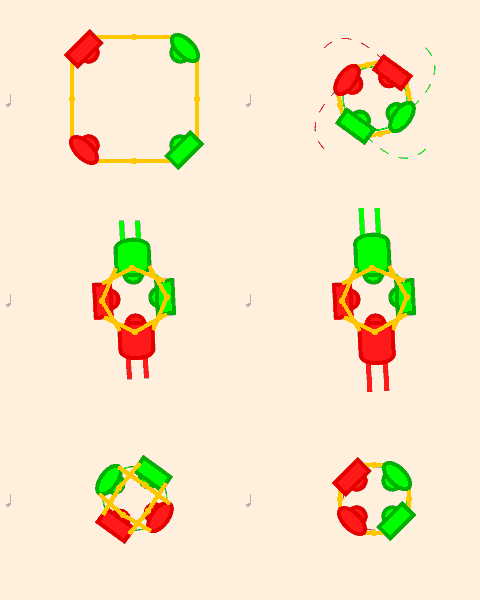 In a basket swing with 2 facing couples, the women take both hands with each other. Then the men bow under the women's hands and take both hands with each other. Then then women duck under the men's hands. And then you circle left.
When I was a teenager the goal was to spin so fast the girls' feet left the ground.
History
The first "Baskets" appear to use all 8 dancers in a square, and although the dancers intertwine themselves they don't circle round or make the ladies fly, they just balance. In the US this became a very standard quadrille figure in the 19th century, and it is found in almost every dancing manual of the period. (It was called a "Promiscuous Figure" which meant (in this case) that The figure was repeated with all four couples leading, and 3rd and 4th times through the gentlemen would form the center circle with the ladies outside.
Hillgrove (New York, 1863) calls it a "Promiscuous Figure" because it could replace either the second or the fifth figure of the standard quadrille.
In 1847 a variant pops up in London for what was called a "German Cotillion" which was danced in a large circle. It involved only 6 dancers.
In the 1890s a variant appears, probably again in a "German Cotillion", where the set may contain an arbetrary number of couples, and has all the ladies form a circle in the middle with all the gentlemen on the outside.
The first basket to involve only two couples seems to be in Cecil Sharp's Running Set, in which he studied Kentucky "Square Dances", published 1918.
John Cole in Selection of Favorite Cotillions, No. 1 (Baltimore, ~1822) published a dance called Basket Cotillion
Forward two _ cross over _ chasse de chasse _ cross to place _ Four ladies forward join hands half round and back and retain position _ Four gentlemen forward join hands half round and back _ The whole form a wreath ballancez and turn partners to place.
(The same words are used in John Klemm's publication from Philadelphia in ~1823)
Huestis & Craft's The Ball-Room Instructer; Containing a Complete Description of Cotillons and Other Popular Dances (New York, 1841) describes a Basket-Dance.
LADIES ROUND THE CENTRE.— Four ladies advance and take hands in the centre—go half round, back, and remain still.GENTLEMEN ROUND.— Gentlemen take hands forming a ring outside of the ladies; gentlemen half round—back to places—all raise hands, and ladies step back from the centre, and pass under the hands of the gentlemen—each lady taking care to be on the right of her partner; all balance and turn partners.
Henri Cellarius's The Drawing-Room Dances (London, 1847, later republished in New York, 1858) is the first example I've found from the UK, with his dance The Basket
Setting out of the first couple. The gentleman chooses two ladies, and places himself between them; the lady chooses two gentlemen and does the same. They advance during four bars, retire during four others, and advance for the last time. The gentleman, who holds the two ladies, raises his harm, and makes the two gentlemen pass underneath, without letting go the hand of the lady of the first gentleman, and give their hands to each other behind the latter. The two ladies, chosen by the first gentleman, join hands behind the conductor's lady, which form the basket. In this position they describe a tour to the left, and at a given signal, without letting go of hands, the gentleman in the middle passes under the arms of the two other gentlemen, and the lady under the arms of the two other ladies. The six have then their arms intwined. At another signal, they disengage their arms, and form an ordinary circle. The describe a round, and the gentleman, who is on the left of the first lady, begins a chaine plate by the right hand, which continues till the first gentleman has recovered his partner. He conclusion is made by promenade at pleasure.
Elias Howe published a quadrille called Basket Set in his Complete Ball-Room Handbook of ~1858:
No. 4. (2 strains) First two forward and back, cross over — chassee across, back — balance and turn partners — four ladies forward and back, join hands and swing quite round, keeping hold of hands — four gentlemen balance, join hands and swing quite round outside of the ladies. Here the music makes a while the basket or wreath is formed, then all balance in that position and turn partners to places next two the same, and so on.
The balance in the basket becomes a circle in the basket in Reilley's The Amateur's Vademecum, A Practical Treatise (Philadelphia, 1870) — but no one else follows this inovation for another 70 years or so:
Leads forward and back 4 bars Half right and left through 4 bars Leads forward and back 4 bars Half right and left to places 4 bars Four ladies to the centre 8 bars All glisse round, and turn partners to places 8 bars
Cecil Sharp came to the US around 1918 and wrote down what he saw of the Square Dancing in Kentucky (which he called the Running Set). In it he describes a figure called The California Show Basket which is the first example I can find with only two couples involved. It also involves a circle after the basket is formed, rather than a balance.
First and second couples hands-across once round clockwise, men joining both hands, and women joining both hands, the men's hands being above the women's.The men raising their hands over the heads of the women and lowering them to waist-level, enclose the women and all four go once round clockwise.The women lift their hands over the heads of the men and rest them on the men's shoulders; while the men raise their hands to the level of the women's necks. In this position all move round once clockwise.First man turns second woman into her place; while first woman turns second man into his place.The first couple repeats these movements with the third couple.The first couple repeats these movements with the fourth couple.It is suggested that the second circuit (i.e., when the men are enclosing the women) should be executed counter-clockwise.
In Kentucky Square Dances, 1928, Ida Levin describes a figure called "Ladies Bow, Gents You Know How"
The Call
- Four hands across, gent's over ladies.
- Ladies bow, gent's you know how.
- Swing your opposite.
- On to the next.
- Next couple out to the right.
- Swing home, corners too.
Description
- First couple walks to the couple on the right. First and second ladies join both hands, first and second gentlemen join both hands across and above the ladies'.
- The ladies stoop under the raised arms of the gentlemen, then the gentlemen stoop under the raised arms of the ladies. Still keeping their hands joined, all walk to the left once around.
- First gentlemen and second lady join both hands and swing once around, simultaneously the second gentleman and first lady join both hands and swing once around.
- See page 5 for description.
Ralph Page describes a figure he calls "Form a Basket" in his The Country Dance Book, 1937 (page 38)
With ladies in the center... facing each other, the men walk forward, so as to stand at the left hand of their partners. Gents now join hands, the ladies bow slightly forward, allowing the men to raise their joined hands over the ladies' heads, the ladies now step back one step and join hands.
He later (pages 75-78) provides a dance which uses the figure along with diagrams, and variations.
BASKET QUADRILLEFirst couple lead to the right, four hands roundCross eight hands, gents bow the ladies know how and around you goRight hands half around, left hands backSwing the opposite ladyAll swing partnersAll promenade.The same couple now repeats the changes with the other two couples. Then the second couple goes through the changes, then the third couple, and then the last. In some localities it is the custom for the second couple to start as soon as the first two begin the changes with the last couple.If you're husky enough, you will perform Gents bow, ladies know how this way:As the gents swing arms over the ladies' heads, they lower them back or the ladies' knees and lift their partners off the floor, basket-seat fashion. The ladies must be taken by surprise and spun violently to get the full effect of this figure.
Lloyd Shaw (in Cowboy Dances, 1939) uses it in the dance "Eight hands over" (pp. 200-203):
THE CALL:Shaw's Cheyenne Mountain Demo team, going like thunder
Copyright (C) by Bob Osgood, Reprinted from Sets in Order, Nov, 1948THE EXPLANATION:
- First couple out to the right
- And eight hands over.
- Ladies bow and the gents bow under,
- Round you go and go like thunder.
- Break and circle four in a ring,
- Docey-doe and a docey-ding.
- On to the next—
- First couple advances to second couple
- The two ladies join both hands across rights to lefts, and the two gentlemen likewise join their hands together over the ladies' hands.
- The two ladies bow low and pass in under the gentlemen's joined arms which are raised and swung back so as to rest around the ladies' shoulders. The gentlemen then bow and pass their heads under the ladies' joined hands, which now rest behind the gentlemen's necks.
- The four dancers break holds, and separating, join hands in a regular circle of four. See page 160 for directions for the docey-doe.
- First couple advances to the third couple and repeats, then to the fourth couple, and returns to place in the square.
Shaw goes on to remark:
Most dancers prefer avoiding the dangers and being less strenuous. They execute this figure in the old form of the California Show Basket. Both ladies' and gentlemen's arms are lowered in part (d) to the others' waists. All four lean back as far as possible, held at the waist, and form a basketlike group, flaring wide at the top. In this position the turn ver slowly to the left. This can be very graceful and beautiful, although the footwork feels awkward to the dancers.
And he provides a third variant full of good comedy:
The men in this case sweep their arms down below the ladies' knees and literally lift them up, so that the ladies are sitting on these intertwined arms at the height of the men's shoulders. If they lean back and out they can form an awkward-looking Etruscan-vase effect, but I laugh more when they lean over and pound the men on the head and squeal, "Let me down! Let me down!"
Northern Junket published a dance with the figure as late as 1955.
The figure seems more rooted in the Quadrille/Square Dance tradition, but it occasionally spilled over into contra dance too. It is not mentioned in 1956 (The Contra Dance Book), nor in 1993 (CDSS 75th Anniversary GEMS) but is present in 1983 in Zesty Contras.
In the 10 years of contra dancing in Santa Barbara I can recall only one dance with a basket swing in it (a three person basket), while my modern western square dance group has never done one (Perhaps CALLERLAB deemed it too dangerous, it isn't one of the standard calls).
John Sweeney also has an article on this figure. And rather to my surprise (given the paucity of UK descriptions) provides a quadrille collected in Cumberland in 1939 which uses the figure — not the US quadrille figure, nor the UK cotillion figure, but the 2 couple square dance figure. The initial publication from 1939 calls it a "pivot ring", but a later publication for 1949 calls it a "basket."
Some dances which (probably) use this figure
- Dances for which I have animations
Note: This list may be incorrect or incomplete.
This website is copyright © 2021-2026 by George W. Williams V My work is licensed under a Creative Commons Attribution 4.0 International License. Most of the dances have more restrictive licensing, see my notes on copyright, the individual dance pages should mention when some rights are waived.