

Set And Link
An online definition may be found here.
Bars: 4.
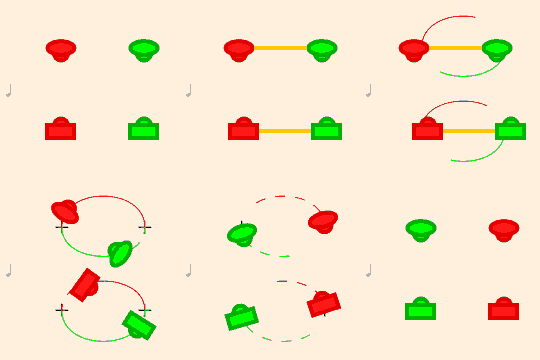
 In a set and link, everyone takes hands on the side and sets to partner, the all drop hands. In a two couple set and link the people on the right end of their lines cast right to the other end of their line, while the people on the left end of the lines spin up or down through the center to the other end of the line.
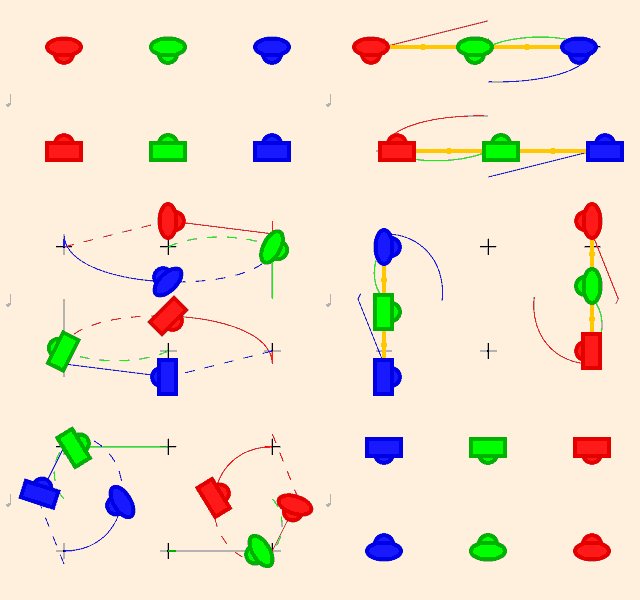
In a three couple set and link life is more complicated, and the dancers switch orientations as well as positions. The person on the left end of the line still twirls through the center to the other end of her/his line and then faces up or down (back the way they came from). The people in the middle cast right and chase a quarter round the set, ending at top or bottom, on the center line, facing in to the set. The people on the right end of the line also cast right, and move to the other end of their sideline.
A 3 couple set and link is often done twice (to get everyone back in the normal orientation, albeit diametrically opposite where they started.
 A four couple set and link is like the 2 couple in that it retains the same orientation. Here the people at the ends of the sidelines cast or twirl one place, while the people in the middle positions cast or twirl two places (so ends become new middles, and middles become new ends).
History
According to the SCDDB John Drewry claims that "set and link" was invented by Alec Hay.
Note. 1 These dances were devised between Spring 1991 and June 1992 i.e. they come after the printing of the Donside Book. Many of them were for use during a visit to New Zealand and California in October-November 1991. The New Zealand connection is emphasised by the inclusion of "set and link" which was devised by Alec Hay of Auckland. Alec said, when I met him, that he prefers dancers NOT TO HOLD HANDS when linking.— The Bankhead Book Part 2, John Drewry, 1991-1992
Looking at Alan Hay's dances, the first use I have found is Australian Ladies, 1966. The first example I have found in an RSCDS Book is in Book 23, 1967, again by Alec Hay, The Dean Bridge of Edinburgh. In both of these the two couple form is used.
The earliest 3 couple Set and Link I've found is in Gang the Same Gate, in RSCDS Book 36 (1990).
The only 4 couple set and link I know of is in The Library of Birmingham, devised 2015.
This figure makes an occasional appearance in English Country Dance, Andrew Shaw's interpretation of Kynaston's Well Done Jack (2002) is the first use I know of it, followed by Brooke Friendly & Chris Sackett's Home Again in 2005.
In his dance Fine Companion Waltz (2008) Gary Roodman describes the figure without naming it. When I asked him if he were using the Scottish figure, he said he hadn't heard of it when he wrote the dance. So I guess he developed it independently.
Some dances which (probably) use this figure
- Dances for which I have animations
- Dances in (R)SCDS Books
Note: This list may be incorrect or incomplete.
This website is copyright © 2021-2026 by George W. Williams V My work is licensed under a Creative Commons Attribution 4.0 International License. Most of the dances have more restrictive licensing, see my notes on copyright, the individual dance pages should mention when some rights are waived.