

Scottish Poussette
An online definition may be found here.
Bars: 8.
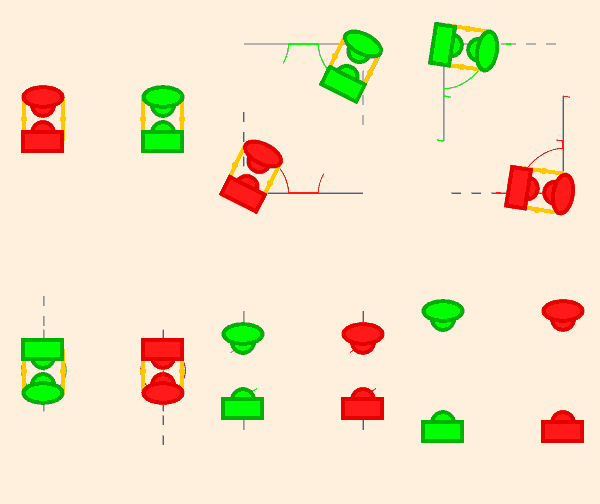 This is a two couple figure which starts with the couples near the center line facing each other with both hands joined.
The 1s dance out so that the man is on the men's line, while the 2s dance so that the woman is on the women's line, then each couple pivots 90° clockwise around the dancer on the sideline, ending so that both couples are now on the sidelines. The 1s move down one place and the 2s up one place, again pivoting 90° clockwise around the other dancer. They now dance in so that they again straddle the centerline, they do a two hand turn half to get on the right sides, and then spend 2 bars falling back to progressed places.
History
In William Campbell's 14th book (~1799) is a dance called Lord Nelson's Waltz. The instructions call for a "Poussette" to fill the last 16 bars (at waltz tempo). Both the Regency Dance site and Alan Winston say this should be a "Waltzing Turn Poussette". As yet I have found no contemporary description of this figure, and rely on Winston's description.
Around ~1820 something called a "Waltz Poussette" appeared. As far as I know no one ever bothered to define it, so we aren't sure what it entailed. However on page 9 of Lowe's Selection of Popular Country Dances (Edinburgh, 1853) in the description of Spanish Country Dance:
Then pousette, Waltzing round each other. (16 Bars)
This is the final figure of the dance, and needs to be progressive. It suggests to me that the two couples waltzed around each other several times (they had 16 bars) before ending in each others' places. Cooper's paper says that in dances imported from Spain the words "waltz" and "poussette" were used synonymously.
Almost all the other dances in Lowe's book use poussettes, but none of them is a waltz, none takes 16 bars, and none says the dancers should waltz around each other. Now if you have to remind people to waltz in a waltz then that suggests to me that normally the poussette took a different form. At least in Edinburgh, in ~1850
Looking back from the 1960s, the Fletts say:
The Pousette. This figure, which is performed by two couples starting from adjacent positions, is one of the principal figures used to achieve the progression down the set. It occurs only in dances in quick tempo and occupies eight bars of music.In the form of the pousette used in Scotland within living memory, the two couples essentially just waltz round each other. The dancers take ordinary ballroom hold or some similar hold with their partners and use a simple waltz-type step, and the two couples move around each other in a counter-clockwise direction to exchange places, each couple at the same time rotating on its own axis in a clockwise direction, making two or more complete turns in the performance of the figure. The two men place their partners in position on the ladies' side, and fall back to their own side with one or two pas de Basque while their partners dance pas de Basque on the spot.
To my mind this is glossing over something important. How do you waltz to a reel or jig? Surely the footwork, at least, is going to be different? Or was "waltz" a broad enough a term to encompass a "partner swing", which can be done with a different traveling step than a waltz step?
In J.F. Wallace's The "Excelsior" Manual of Dancing, Glasgow, 1872, he describes "The British Grenadiers" (a reel). In it the poussette needs to be progressive. He describes it as Pousette, (using Galop step, making a half turn with each, (and breaks off without finishing his sentence or closing his parenthesis). In his publication from ~1900 he does close his parenthesis but we are no closer to knowing what "each" might modify. My guess is "step", and that this is a variant of a waltz poussette, turning halfway on each Gallop step — but remember this dance is a reel, not a waltz — indicating that the "waltz poussette" had extended to other types of music by 1872 (in Glasgow).
In Wallace's book, as in Lowe's, the poussettes used with waltz music are usually 16 bars, and the first one has the comment "still using the waltz step" as if this were unusual in a poussette.
Anderson (Dundee, 1897) also has to mention that a poussette in a dance with waltz music should be just waltzing.
Note that in 1964 the Fletts said It occurs only in dances in quick tempo. And a waltz is not a quick tempo dance. Does this mean that the "waltz poussette" wasn't used in waltzes in the Fletts' "living memory"? or that no one was doing country dances to waltz music by then? Except Anderson suggests that there were waltz country dances in 1897 which used waltz poussettes...
Anyway according to the Fletts, prior to the (R)SCDS, poussettes consisted of just waltzing around the other couple, suggesting that the (R)SCDS invented their poussette, and dances using it would, therefore, not be danced in a traditional way.
So, I'm pretty sure that the first use of this poussette was in the first book published by the (R)SCDS in 1924. And the first dance in that book is Petronella.
Some dances which (probably) use this figure
- Dances for which I have animations
- Dances in (R)SCDS Books
Note: This list may be incorrect or incomplete.
See Also
This website is copyright © 2021-2026 by George W. Williams V My work is licensed under a Creative Commons Attribution 4.0 International License. Most of the dances have more restrictive licensing, see my notes on copyright, the individual dance pages should mention when some rights are waived.