

Table of Contents
B
| Dance Title | Type | Deviser (or Editor/Publisher), Date, Interpreter | Music Performers | Formation |
|---|---|---|---|---|
| Blue Bonnets over the Border |  | W. Smyth 1830 George Williams 2023 |  | Duple Minor |
C
| Dance Title | Type | Deviser (or Editor/Publisher), Date, Interpreter | Music Performers | Formation |
|---|---|---|---|---|
| Clydeside Lasses ~ Williams | | Lowes ~1831 George Williams 2024 | | Duple Minor |
| Cumberland Reel ~ Wilcock | | Thompson ~1786 H. D. Wilcock 1868 | | 4 Couple Longways permutation: 2341 |
H
| Dance Title | Type | Deviser (or Editor/Publisher), Date, Interpreter | Music Performers | Formation | |||||
|---|---|---|---|---|---|---|---|---|---|
The Hungarian Waltz
| |||||||||
M
| Dance Title | Type | Deviser (or Editor/Publisher), Date, Interpreter | Music Performers | Formation |
|---|---|---|---|---|
| Meg Merrilees ~ MS3860 | | MS3860 ~1825 George Williams 2026 | | Duple Minor |
N
| Dance Title | Type | Deviser (or Editor/Publisher), Date, Interpreter | Music Performers | Formation |
|---|---|---|---|---|
| The Nut ~ Williams | | Lowe ~1831 George Williams 2023 | | Duple Minor |
P
| Dance Title | Type | Deviser (or Editor/Publisher), Date, Interpreter | Music Performers | Formation | ||||||||||||||||||||
|---|---|---|---|---|---|---|---|---|---|---|---|---|---|---|---|---|---|---|---|---|---|---|---|---|
Patronella
| ||||||||||||||||||||||||
| The Princess of Wales' Fancy | | Lowe ~1831 George Williams 2025 | | Custom | ||||||||||||||||||||
R
| Dance Title | Type | Deviser (or Editor/Publisher), Date, Interpreter | Music Performers | Formation |
|---|---|---|---|---|
| Rachel Rae ~ Williams | | W. Smyth 1830 George Williams 2023 | | Triple Minor |
T
| Dance Title | Type | Deviser (or Editor/Publisher), Date, Interpreter | Music Performers | Formation | |||||
|---|---|---|---|---|---|---|---|---|---|
La Tempete
| |||||||||
| Number of dances | Number of versions | Number with music |
|---|---|---|
| 8 | 12 | 2 |
Warning: The set of figures for each dance is generated programmatically by regular expression matching and may be in error. Also, for old dances, they reflect the figures used by the interpreter which may not match those of the deviser.
Old Scottish Poussette
An online definition may be found here.
Bars: 8.
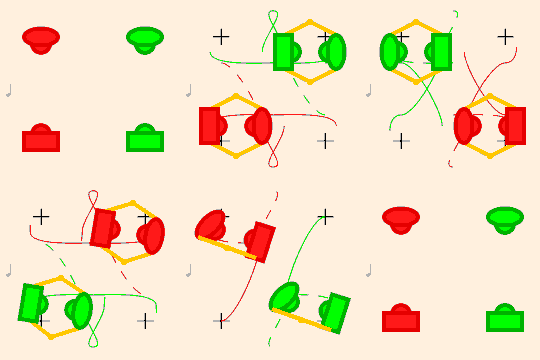 The version of the poussette used in Scotland in the 19th century was different from that used in England in the 18th and different again from that invented by the (R)SCDS in the 20th.
This is a two couple figure. Dancers start facing partners near the center line. They take both hands. The center of each couple describes a counter-clockwise circle about the middle of the minor set, meanwhile each couple turns clockwise about its own center doing half a turn every time they move 90° about the bigger circle. (so each dancer is like a moon orbiting a planet orbiting a star). It took two bars to move 90° about the large circle.
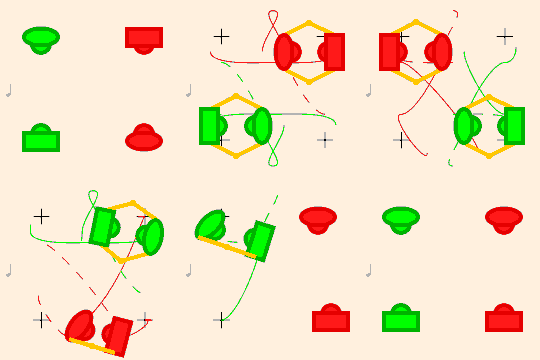 If one (or both) of the couples started improper then they only make 3 half turns about their common center, leaving them proper, (for a total of 6 bars) but somehow still end up where they started, and use the remaining two bars to set to each other.
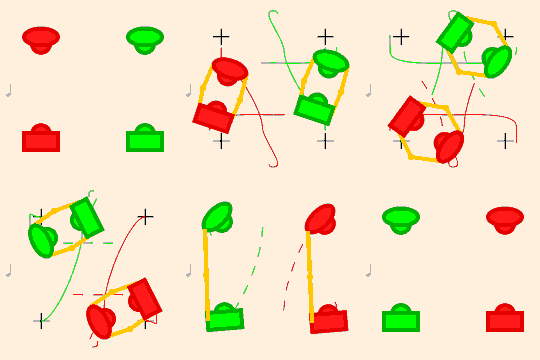 There was also a half poussette, which only took 4 bars and was progressive.
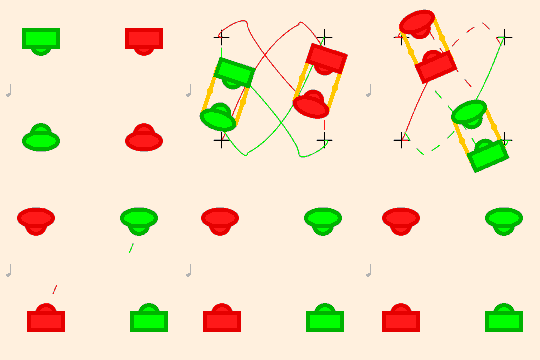 The half poussette could also be used to bring improper dancers back to proper (presumably the same way as above). This has the same effect as the modern "draw poussette", but uses a different path.
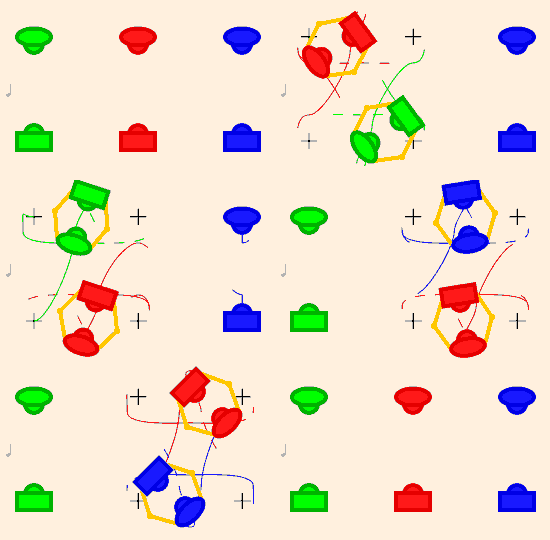 There was also a double poussette (though I’ve never seen any dances which used it). In it the middle couple first danced a full poussette with the couple above them, and then another with the couple below. All ending where they started, taking a total of 16 bars.
The poussette seems to have changed during the course of the 19th century, or perhaps there were regional differents. The Fletts, in 1964, describe a very different poussette than this one, one involving waltzing.
History
In Thomas Wilson’s A Companion to the Ball Room, London, 1816 he introduces something called a "waltz whole poussette" for the dance L’Augustin Waltz on page 143. In a footnote he explains that he will bring out a book describing it. But if he did, I can’t find a copy. As far as I know no one else in England ever bothered to define it, so we aren’t sure what it entailed.
The National Library of Scotland has a manuscript (MS 3860), probably written between 1820 and 1830, which contains a description of what "Poussette" meant to the author. Perhaps this is the Waltz Poussette? The dancers do not use ballroom position though. Dancers start near the center line (this isn’t mentioned in the section on Poussette itself, but appears in the descriptions of the country dances later) and take both hands with partners and the couple moves in a large counter-clockwise circle around the other couple (as in a traditional poussette), but also the couple describes a clockwise epicycle about their center point. Each time the couple has moved 90° around the big circle, they have turned 180° around their epicycle. (Like a moon orbiting a planet orbiting a star).
The author describes a half poussette (which is progressive, and takes 4 bars), a full poussette (which is not progressive, and takes 8 bars) and a double poussette where the center couple of a triple minor does a full poussette with the top couple and then another with the bottom couple (non progressive, 16 bars). He also goes on to explain what to do if one couple starts improper, saying they should end the figure proper. This explains a number of 19th century Scottish dance descriptions where such behavior is needed.
This manuscript says in several places (here and here) that Sauteuse Waltzing steps should be used for the country dance poussette. I don’t understand how one can use waltz steps in a reel or jig though. In very faint ink, on page 104 there is a description of what these steps entailed.
Pousset Ascend by the Satteuss waltzing Step.(or the steps used by M1, W2)
Left into Pos: IV before
Follow up right into Pos: III.½
½
Right into Pos: IV behind &
Pirouette with a spring.
into Pos III right before½
½
I have looked though 11 dance manuals from the 19th and early 20th centuries from Scotland, Ireland, and the north of England. In them the poussette is almost always preceded by "down the middle, up again" so it can be hard to tell which of the two is progressive.
But we know that in MS 3860 "down the middle, up again" was progressive. In almost all the other books I looked at there are dances where "down the middle, up again" is used alone, and in these cases it needs to be progressive: (The Fairy Dance for instance). In almost all the books there are dances were there are non-progressive stand-alone poussettes (Captain White for instance). So it seems likely that in most cases, even around 1900, the 8 bar poussette was non-progressive.
In D. Anderson’s Ball-Room and Solo Dance Guide (Dundee, 1897) there are 10 dances (out of 42 total dances with poussettes) where couples start the poussette improper and need to be proper at the end of it. These are also all non-progressive poussettes in 8 bars. The poussette described in MS 3860 has this property.
There are also a few dances which appear to use a progressive half poussette that fits into 4 bars. Oddly the instructions don’t call it a half poussette, they just say "poussette". For instance in St. Patrick’s Day:
Four hands across half round and poussette, back to places, the first couple down the middle and turn half round and up again, four hands round at top, then turn to proper sides.
Here the poussette must undo the effects of four hands across half, so it must be progressive, and return people to their proper sides. This all seems to fit the description of poussettes and half poussettes given in MS 3860.
But there are some counter-examples
The Waltz Country Dance also called The Spanish Dance, or The Guaracha, (or some combination) has a 16 (later 8) bar progressive poussette described in Lowe’s Selection of Popular Country Dances (Edinburgh, 1853) as:
Then pousette, Waltzing round each other. (16 Bars)
As far as I can tell this version of the poussette is only used in this dance or slight variations of it. This may be the same as Campbell’s "Waltzing Turn Poussette"? It seems odd that one needs to remind people to waltz in a waltz so that suggests to me that this dance is an aberration and normally the poussette took a different form.
Then around 1870 we start finding a few progressive 8 bar poussettes, as in The British Grenadiers.
Bars of Music
1. Gentlemen No. 1, 2, and 3 join hands and advance and retire, 4 2. Ladies No. 1, 2, and 3 do likewise, 4 3. The three couples promenade to places, 8 4. Gentlemen No. 1 and 2, and ladies No. 1 and 2, give right hands across, back giving left, 8 5. Pousette, (using Galop step, making a half turn with each, 8
I can’t help but wonder... given that St. Patrick’s Day above uses "poussette" to describe a half poussette, if this might just be another half poussette masquerading as a full one. MS 3860 says to fill up unused music with setting (when describing an improper poussette), so perhaps that should be done here too.
This last line is frustrating, it is as if the author intended to describe a poussette, but broke off right after beginning. However it does sound rather like the description in MS 3860 where couples do a half turn about their own center as they turn 90° about the center of the minor set. Wallace published another book in ~1900 with the same words describing the poussette. So presumably he thought the poussette hadn’t changed in the intervening 30 years.
Note that this description does not fit the (R)SCDS poussette which involves two quarter turns and a half turn, nor their diamond poussette.
Looking back from the 1964, the Fletts say:
The Pousette. This figure, which is performed by two couples starting from adjacent positions, is one of the principal figures used to achieve the progression down the set. It occurs only in dances in quick tempo and occupies eight bars of music.In the form of the pousette used in Scotland within living memory, the two couples essentially just waltz round each other. The dancers take ordinary ballroom hold or some similar hold with their partners and use a simple waltz-type step, and the two couples move around each other in a counter-clockwise direction to exchange places, each couple at the same time rotating on its own axis in a clockwise direction, making two or more complete turns in the performance of the figure. The two men place their partners in position on the ladies’ side, and fall back to their own side with one or two pas de Basque while their partners dance pas de Basque on the spot.Usually the two couples just passed directly into each others place, as in Diagram 10.2, but sometimes they circled round each other one and a half times; in neither case were the turns made in a precise manner. The poussette is also sometimes performed with one of the two couples starting improper; here the relevant couple simply insert an extra half turn into the figure.
Diagram 10.2
This seems rather like what might happen to a figure which became sloppier over the years. Instead of the precise: "half turn about the small circle for every quarter turn about the big" it becomes "in neither case were the turns made in a precise manner". Then instead of the two hand hold we have a ballroom hold as that became more common. Note that this retains the ability to make a couple proper.
The Fletts say that poussettes only occurred in quick tempo dances, but we know they occurred in Waltz Country Dance, which was not quick tempo.
The difference I find most surprising is the change from non-progressive to progressive. It still looks to me as if, even in the books written in ~1900, most of the poussettes were non-progressive. Of course, it might be that the dancing masters in the cities were more conservative, and their books reflect what they wanted their students to do, rather than what rural dancers were actually doing.
In any case both the version of the poussette described by MS3860 and that described by the Fletts are quite different from that used by the (R)SCDS. The Fletts say on page 237 that This particular form of poussette was developed during the early days of the Society, and is apparently a modification of a poussette invented about 1925 by Mr. John Duthie. It was invented, and is not a traditional figure.
I have heard it argued that Miss Milligan did not have access to the books that explained what the old figures meant, so, just as Cecil Sharp invented swirly siding, she invented her figures. This may explain allemande and double triangles, but it does not explain poussette. Here the figure was still extant and she deliberately chose something else.
So any modern Scottish Country Dances involving a poussette are not danced in a traditional way.
See Also
This website is copyright © 2021-2026 by George W. Williams V My work is licensed under a Creative Commons Attribution 4.0 International License. Most of the dances have more restrictive licensing, see my notes on copyright, the individual dance pages should mention when some rights are waived.